


Review of Oneitwoh Broker
Oneitwoh presents itself as an international broker offering retail clients access to a range of financial markets and liquid trading instruments. The company claims to have been operating since 2018 and promotes its own trading terminal, cooperation with major liquidity providers, professional awards, and a selection of trading accounts designed for different types of clients.
At first glance, the platform attempts to create the image of an established international financial company. However, several important details remain difficult to verify. The broker does not provide clear evidence supporting its claimed licenses, its corporate information is limited, and the current domain history does not fully correspond with the company’s stated operating history.
This Oneitwoh broker review examines the company’s regulatory claims, contact information, website infrastructure, trading conditions, legal documents, withdrawal procedures, and available client complaints.
Oneitwoh Regulation and License Check
Oneitwoh claims that its activities are supervised by several well-known financial regulators, including the CSSF, FCA, VFSC, and DFSA. These are presented as evidence that the company operates under international financial standards.
However, the website does not provide license numbers, copies of licenses, registration certificates, or other documents that would allow clients to independently verify these claims. The relevant regulatory databases also reportedly do not contain information confirming that Oneitwoh is authorized by the regulators mentioned on its website.
The regulators referenced by the broker include the CSSF, FCA, VFSC, and DFSA.
This is an important distinction. A broker mentioning the name of a respected regulator on its website is not the same as being licensed by that regulator. A legitimate financial company should be able to provide a legal entity name, license number, jurisdiction, and a direct way to verify its authorization.
The available materials also indicate that Oneitwoh was checked against the database of the Central Bank of Russia. According to those materials, the broker was added to the regulator’s warning list on April 29, 2026, with signs of an illegal professional participant in the securities market being identified.
The combination of unverified international licensing claims and the reported warning-list status creates a significant regulatory concern. Potential clients should therefore not rely on the broker’s own statements about regulation without independent confirmation.
Oneitwoh Company Information and Contact Details
Oneitwoh lists Argentina as its jurisdiction and provides the following address:
Santo Tome 3096, C1417GFO, Autonomous City of Buenos Aires, Argentina.
The company also provides [email protected] as its customer-service email and lists the telephone number +54 9 11 4728-5931.
On paper, the broker therefore appears to provide the basic contact information expected from a financial company. The problem is that these details are difficult to verify independently.
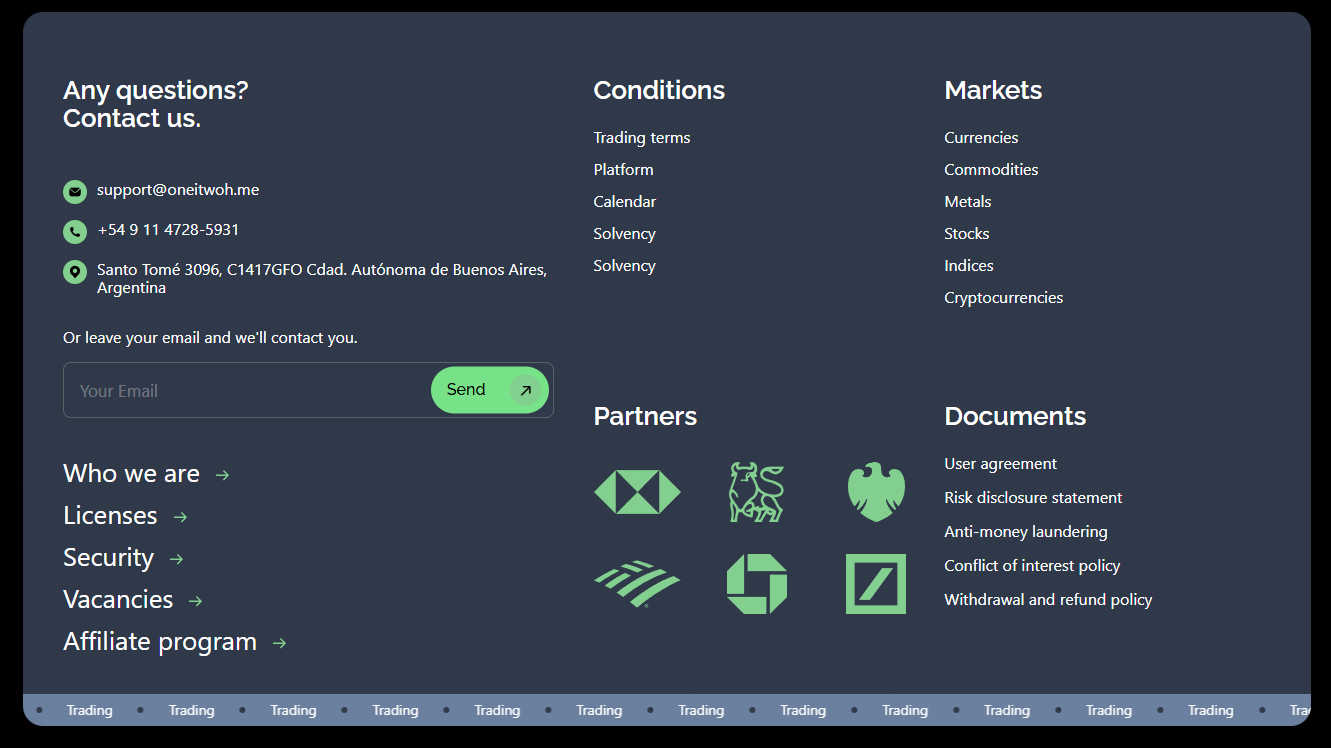
According to the available checking results, the listed email address does not appear to be properly registered. Users have also reported difficulties obtaining a direct response from the company’s representatives.
The telephone number raises similar concerns. User reports indicate that attempts to reach the company may result in a fax response rather than a normal conversation with customer support.
The physical address also requires caution. Although the location in Buenos Aires exists, the available information does not provide reliable confirmation that Oneitwoh actually operates there. The provided checks indicate that the broker is not registered at this location despite claiming to have operated since 2018.
For a company presenting itself as an established international broker, the lack of easily verifiable corporate information is a significant weakness. Clients should be able to identify the legal entity behind the platform and establish where it is actually registered and regulated.
Oneitwoh Websites and Domain Structure
Oneitwoh operates through several domain names:
- oneitwoh.me;
- ont-woh.com;
- oneit-woh.link.
The primary website is oneitwoh.me, while the other addresses are presented as related resources.
Using multiple domains is not automatically suspicious. Financial companies may use separate domains for their main website, client area, or technical infrastructure. However, in this case, the purpose and ownership of the different domains are not explained clearly enough.
The domain history also raises questions about the company’s claimed history.
Oneitwoh Trading Accounts and Conditions
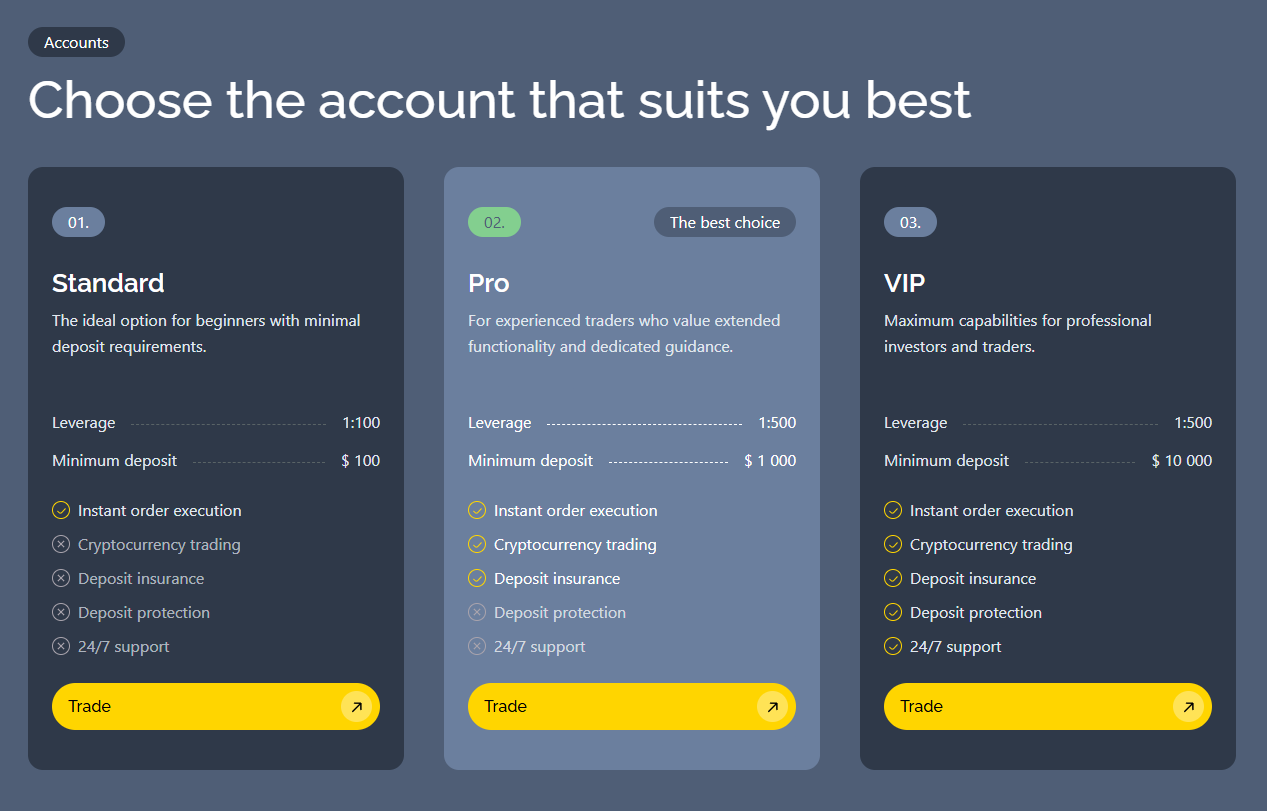
Oneitwoh advertises three main account types: Standard, Pro, and VIP.
The Standard account starts at $100 and provides advertised leverage of up to 1:100. The broker also claims that trading orders are processed instantly.
The Pro account requires at least $1,000 and offers leverage of up to 1:500. Clients are also promised access to cryptocurrency trading and capital insurance.
The VIP account starts at $10,000. It also offers leverage of up to 1:500, together with a 24/7 manager, priority execution, and claims concerning the security of client funds.
The account structure is designed to encourage larger deposits by attaching additional features to higher funding levels. However, several important trading parameters remain unclear.
The broker does not provide sufficient information about spreads, commissions, execution conditions, liquidity providers, or other costs that may affect the actual profitability of trading.
The leverage is another significant point of concern. Oneitwoh advertises leverage of up to 1:500, while retail trading rules in the European regulatory environment impose substantially lower limits, including a maximum of 1:30 for major currency pairs.
This does not automatically prove that the broker is violating European law, particularly if it is not operating under an EU license. However, the extremely high leverage is inconsistent with the standards normally applied to regulated European retail brokers and should therefore be treated as a risk factor.
Oneitwoh Legal Documents and Policies
The broker provides several documents on its website, including:
- User Agreement;
- Risk Disclosure Statement;
- Anti-Money Laundering Policy;
- Conflict of Interest Policy;
- Withdrawal and Refund Policy.
At first glance, the presence of these documents may create the impression of a structured and regulated financial business. However, the substance of the documents is more important than their number.
According to the provided materials, Oneitwoh’s documents do not contain sufficient legal information to clearly identify the company responsible for the platform. Registration numbers and complete corporate details are reportedly absent.
This creates a serious problem for clients. If an agreement does not clearly establish the legal identity of the service provider, its registration jurisdiction, and the applicable legal framework, it becomes difficult to understand who is responsible for client funds or how a dispute can be pursued.
The documents also reportedly contain broad provisions limiting the broker’s responsibility in situations involving account restrictions, losses, and other disputes.
Such clauses are particularly concerning when the underlying company and regulatory status cannot be independently verified.
Oneitwoh Withdrawal Conditions
Oneitwoh advertises several payment methods for clients. These include cryptocurrency transactions, bank transfers, payment cards, and electronic wallets.
The broker states that withdrawal requests can take up to 72 hours to process. However, important details such as withdrawal limits and the full schedule of applicable fees are not clearly disclosed.
The available information also contains user reports concerning the way deposits are processed. Some clients claim that they were instructed to transfer money to third-party cards or cryptocurrency addresses rather than directly to a clearly identifiable corporate account.
This is an important issue because clients should know exactly which legal entity receives their funds.
The more serious complaints concern the withdrawal stage itself. According to users, attempting to withdraw money can trigger requests for additional payments. These may reportedly be described as taxes, insurance, commissions, tax-code verification fees, or other mandatory charges.
In some cases, clients claim that they were also asked to involve a beneficiary or trusted person in the process.
A repeated requirement to send additional money before an already displayed balance can be withdrawn is a major warning sign. Legitimate trading platforms should clearly disclose their withdrawal requirements and fees before clients fund their accounts rather than introduce new payment conditions only after a withdrawal request is submitted.
Conclusion on Oneitwoh
The available information presents Oneitwoh with a substantial number of unresolved issues.
The company claims to have operated since 2018 and refers to regulation by the CSSF, FCA, VFSC, and DFSA. However, no license numbers or official documents are provided, and the claimed regulatory status has not been independently confirmed in the relevant registers.
The broker’s corporate information is also difficult to verify. The listed email address raises questions, users report problems reaching the telephone number, and the stated Buenos Aires address does not provide convincing evidence of an established corporate presence.
The domain history creates another discrepancy. The main oneitwoh.me domain was registered in 2021, several years after the company’s claimed launch in 2018. Its ownership is hidden, its trust indicators are weak, and the provided IPQS results reportedly contain complaints related to phishing and fraudulent activity.
The trading conditions present additional risks. Oneitwoh advertises leverage of up to 1:500, while providing limited information about spreads, commissions, execution, and liquidity. Its legal documents also lack sufficient corporate details to clearly establish the legal entity responsible for client accounts.
Most importantly, the withdrawal process is surrounded by serious complaints. Users report additional payment demands, problems accessing their funds, transfers to third-party payment methods, and concerns regarding the LogicPort trading environment.
Based on the available information, Oneitwoh cannot be regarded as a transparent and reliably regulated broker. The combination of unverified licensing, unclear corporate information, questionable domain history, aggressive leverage, limited disclosure of trading conditions, and repeated withdrawal complaints represents a substantial risk for potential clients.
Anyone considering depositing funds with Oneitwoh should independently verify the company’s legal entity, regulatory authorization, ownership, payment arrangements, and withdrawal procedures before transferring any money.



Reader reviews (0)
No reader reviews yet