


BitNest Review
BitNest presents itself as a decentralized crypto-financial ecosystem designed to give users access to passive-income products through blockchain technology and smart contracts. Unlike a conventional cryptocurrency exchange focused on spot trading, BitNest puts investment products at the center of its business model. Users can connect a crypto wallet, deposit USDT and select a product promising a predetermined return.
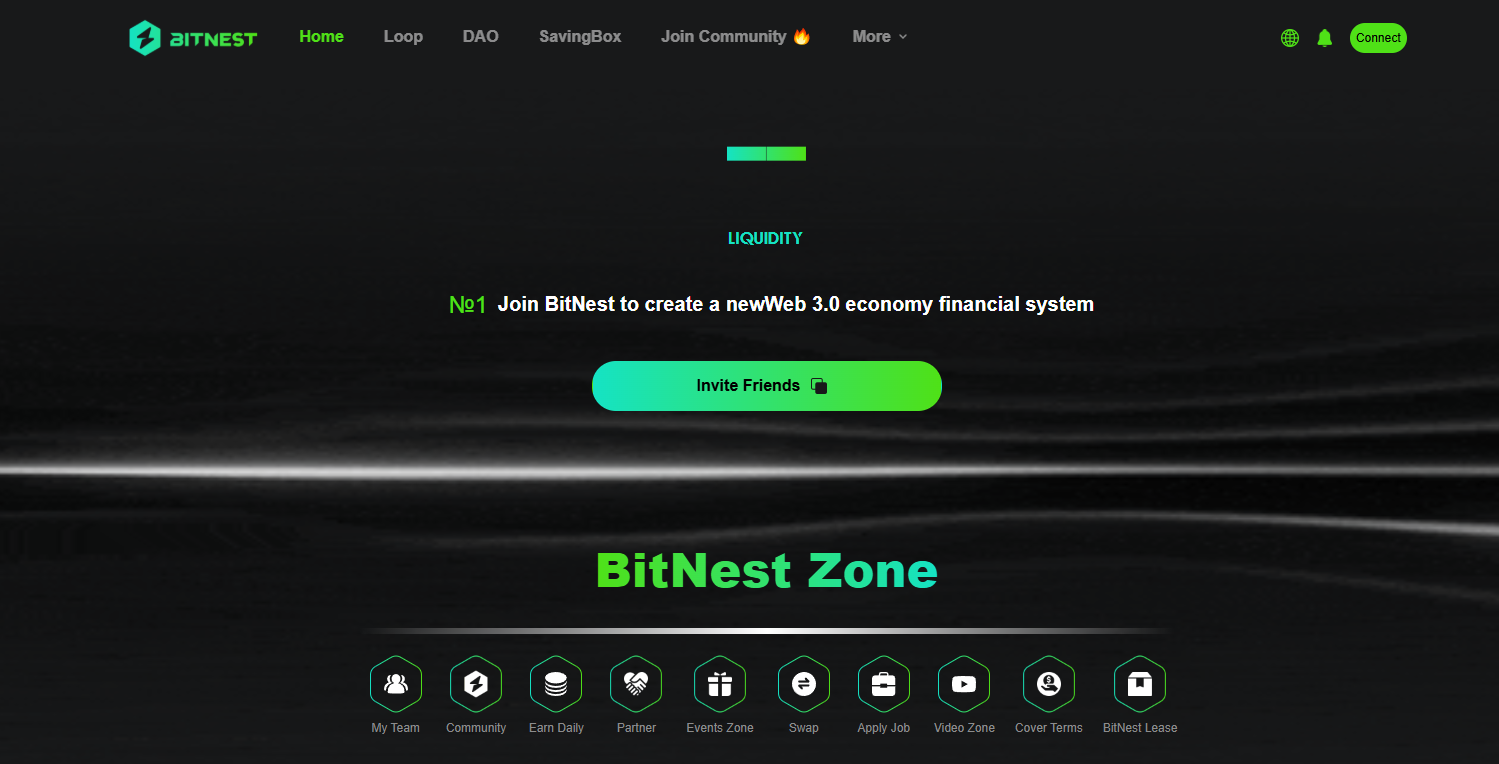
The platform’s investment model deserves closer examination because its advertised returns are unusually high for products presented as passive and relatively simple. Saving Box advertises a fixed return of 0.4% per day, while BitLoop offers predefined returns based on investment periods ranging from one to 28 days. At the same time, BitNest provides limited information about the company operating the platform, its jurisdiction, licensing status and the economic mechanism that supposedly generates these returns.
What Is BitNest?
BitNest describes itself as an ecosystem for managing digital assets through decentralized technologies. The platform combines several products, including Saving Box, BitLoop, Bitnest Savings and Bitnest DAO, while also promoting its own MellionCoin token.
The service does not operate like a traditional centralized exchange where users create an account, deposit funds with the company and trade through an internal order book. Instead, the platform uses a wallet-based model. Users connect a cryptocurrency wallet such as MetaMask and authorize blockchain transactions themselves. According to the available description, the selected products are then accessed through smart contracts.
This distinction is important. Calling a platform decentralized does not eliminate financial or operational risk. The user may retain control of the wallet, but the assets can still be exposed to smart-contract vulnerabilities, liquidity problems, unclear withdrawal conditions and weaknesses in the underlying economic model.
BitNest Company Information
One of the first issues raised by an assessment of BitNest is the limited amount of corporate information available to potential users. The platform does not provide sufficient publicly verifiable information about the legal entity behind the service, its country of registration or its financial licenses.
The available materials identify 2023 as the project’s launch year, but do not provide confirmation of a registered company or regulatory authorization. A physical business address is also not disclosed.
This creates a significant distinction between technical accessibility and legal accountability. A user may be able to interact with BitNest directly through a blockchain wallet, but that does not tell the user which legal entity is responsible for the platform or which jurisdiction would handle a dispute.
For an investment service offering predefined returns, the identity and legal status of the operator are particularly relevant. Without this information, it is difficult to establish what consumer protections, dispute mechanisms or regulatory obligations apply to the platform.
How the BitNest Model Works
The basic user journey is built around a cryptocurrency wallet. After opening the platform, the user connects a compatible wallet and approves the connection. The user can then select an investment product and specify the amount of USDT to be deposited.
The transaction is confirmed through the wallet rather than through a conventional bank payment or centralized exchange account. Once the blockchain transaction is confirmed, BitNest states that the relevant smart-contract logic determines the subsequent calculation and repayment of funds.
This structure reduces the need for a conventional account infrastructure, but it also shifts more responsibility to the user. Wallet access, private keys and transaction approvals become critical. If a user loses access to the wallet, BitNest cannot simply reset the account in the same way a conventional financial institution could reset an online banking password.
There is also a separate transaction-security risk. Users must verify the domain they are accessing and examine every transaction or signature request before approving it. A malicious clone of a decentralized application can potentially create a much more serious problem than an ordinary phishing login page because the user may authorize an on-chain transaction directly from the wallet.
Saving Box and the 0.4% Daily Return
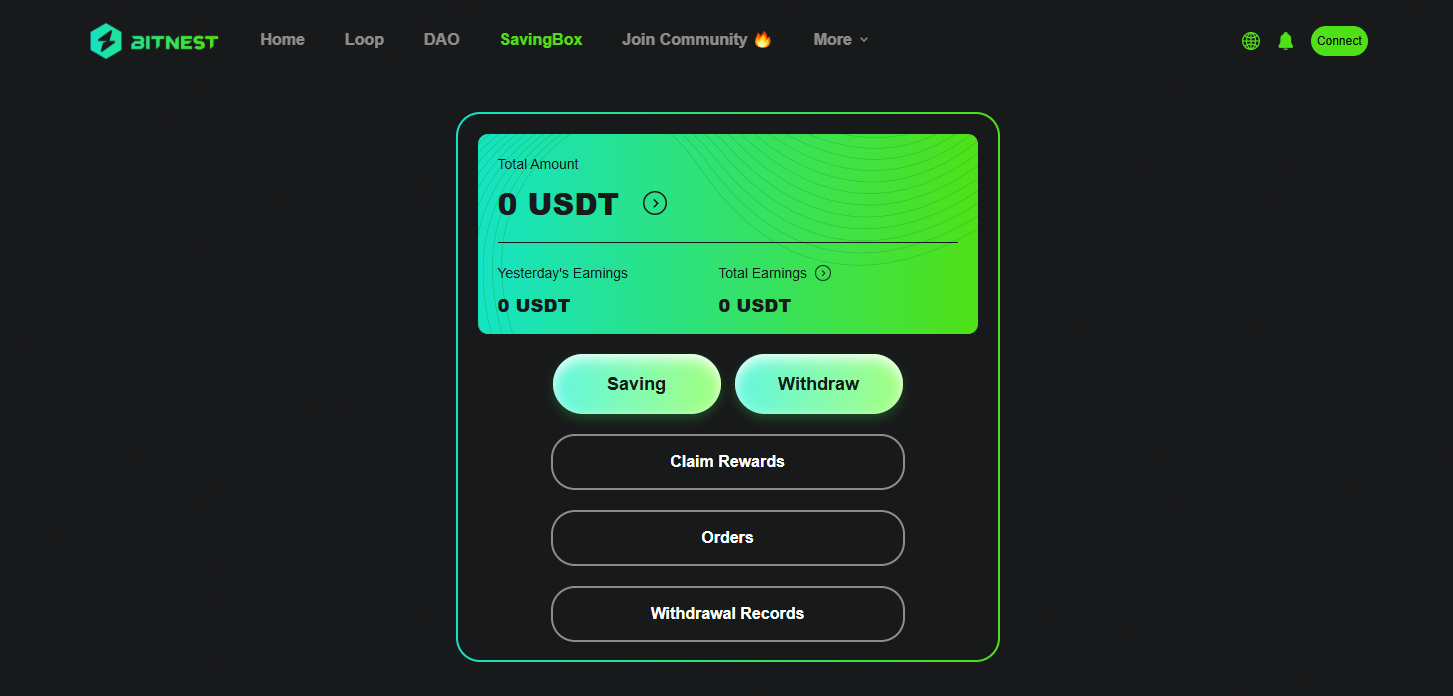
Saving Box is one of the most important BitNest products. It is described as a mechanism connected to PancakeSwap in which users deposit USDT and receive a fixed daily return.
The advertised rate is 0.4% per day, with automatic accruals every 24 hours. The platform states that there is no minimum deposit requirement and that users can make deposits and withdrawals without waiting for a predefined investment period. A 0.1 USDT fixed withdrawal fee is also mentioned, separate from blockchain network fees.
The main concern is not simply that 0.4% sounds attractive. The problem is the fixed nature of the return.
In a conventional DeFi liquidity pool, yield is generally influenced by market activity, trading volume, liquidity demand, fees and other changing variables. A fixed daily return requires a different source of funding or a mechanism capable of maintaining that payment independently of short-term market conditions.
BitNest’s publicly available description does not provide enough information to independently establish how the 0.4% return is generated. This makes the advertised yield one of the most important factors to investigate before depositing funds.
BitLoop Investment Cycles
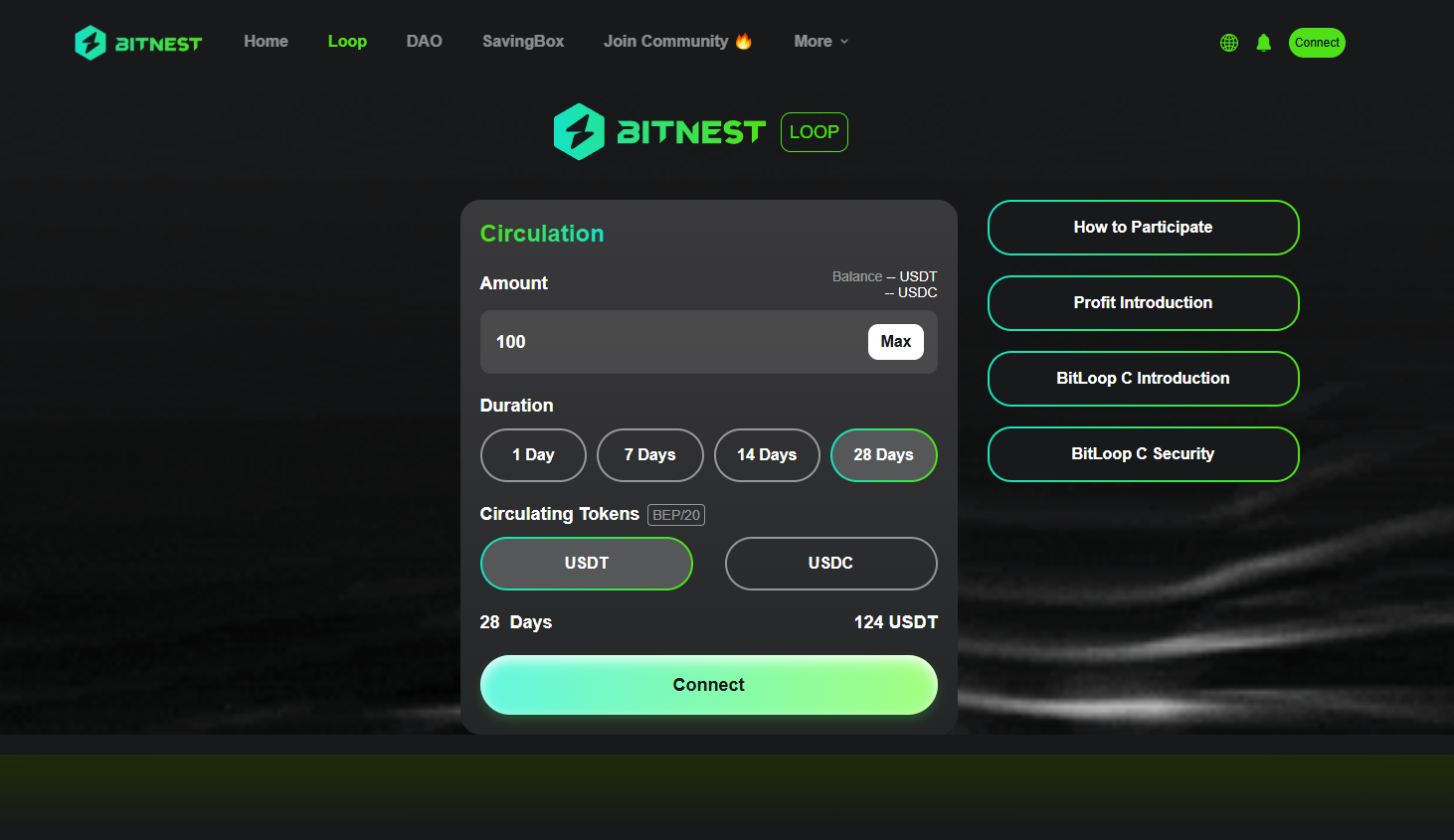
BitLoop uses fixed investment periods rather than the open-ended structure described for Saving Box. Users can select a period between one and 28 days, with the platform specifying the amount returned at the end of the chosen cycle.
The published figures are 100.4% after one day, 104% after seven days, 109.5% after 14 days and 124% after 28 days.
The 28-day figure is particularly significant. Under the stated terms, a user depositing 1,000 USDT would receive 1,240 USDT at the end of the cycle. That represents a 240 USDT return on the original amount within four weeks.
Such a structure requires a clear and verifiable explanation of the underlying revenue source. The relevant question is not simply whether the smart contract can technically distribute the specified amount. The question is where the additional assets come from and whether the model can continue generating enough value to meet those obligations.
The publicly available information does not provide enough detail to independently verify the sustainability of the BitLoop return mechanism.
Bitnest Savings
Bitnest Savings is presented as another method of holding crypto assets within the ecosystem. Compared with Saving Box and BitLoop, however, its public description is less detailed.
The available information does not fully explain the product’s limits, complete conditions or exact calculation methodology.
For users, incomplete disclosure matters because the headline concept of “saving” does not explain the actual risk profile. Before treating such a product as a substitute for conventional crypto custody, users would need to understand where the assets are held, what smart contracts control them, how withdrawals work and what happens if the underlying protocol becomes unavailable.
Bitnest DAO and MellionCoin
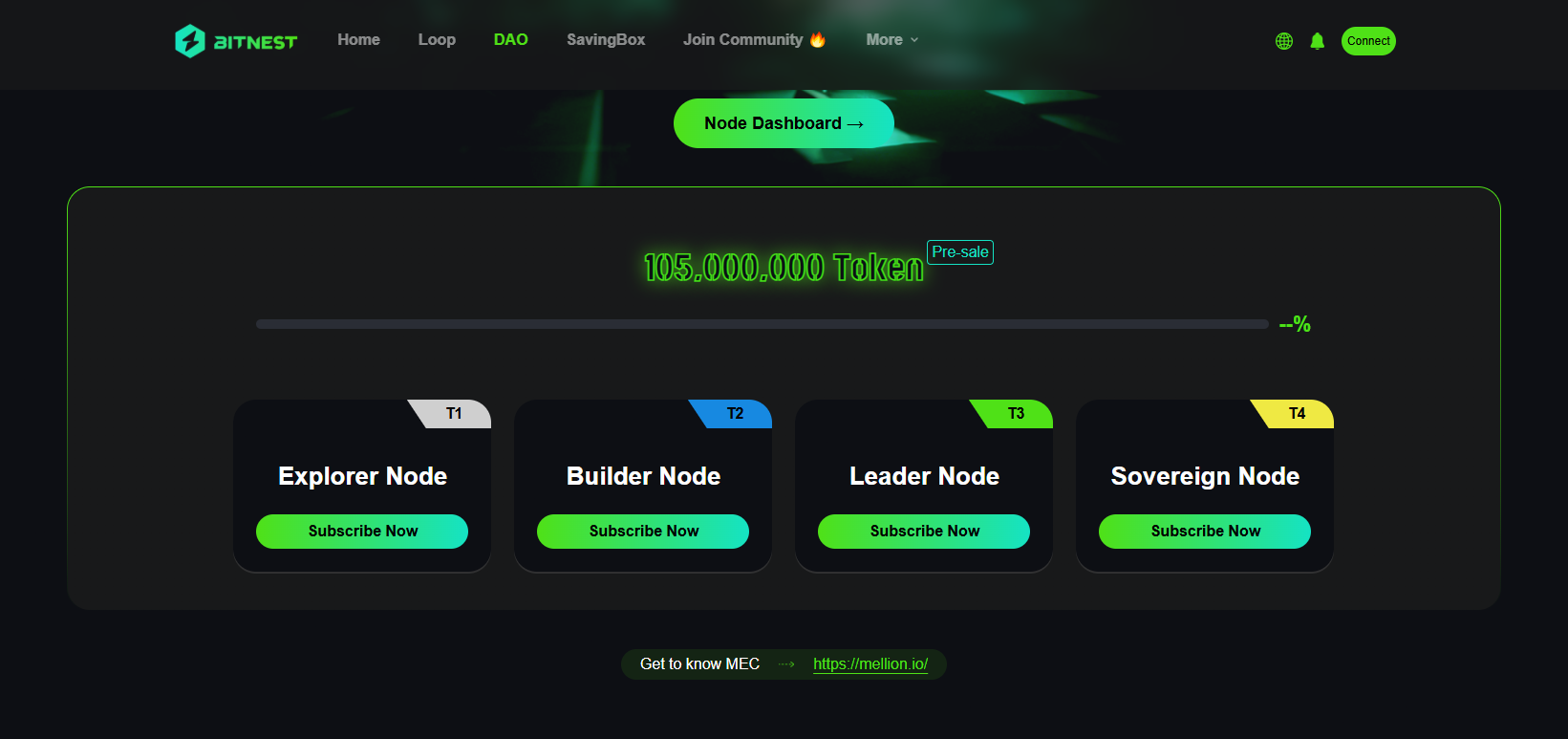
BitNest also promotes Bitnest DAO and its own MellionCoin token. The DAO is presented as part of the ecosystem’s internal economy and the distribution of MellionCoin. However, the available documentation provides limited financial and legal detail about this structure.
An internal token introduces an additional layer of risk. The advertised value of an investment is not necessarily equivalent to the amount that can actually be withdrawn in USDT or another liquid cryptocurrency. The practical value of a token depends on liquidity, market demand, token supply, exchange availability and its actual utility.
Therefore, users should distinguish between receiving an asset inside the BitNest ecosystem and receiving a liquid cryptocurrency that can be independently traded or converted.
The 17-Level Referral Structure
The referral system is another major component of the BitNest model. The platform’s published structure reportedly extends to 17 levels and provides different rewards depending on the level of the referred participant.
The first level offers a 20% reward based on the income of referred users. Other levels provide smaller percentages, including 10%, 5%, 3% and 1%.
This structure is relevant because it creates an additional incentive to bring new participants into the ecosystem. A conventional referral program can be used by legitimate businesses as a customer-acquisition tool, so the existence of referrals alone does not establish misconduct.
The risk increases when a multi-level referral system is combined with unusually high fixed investment returns. In that situation, it becomes necessary to establish whether the promised returns originate from a productive underlying activity or whether participant inflows play a material role in sustaining the system.
The deeper the referral structure, the more important this distinction becomes.
Deposit Requirements and Transaction Fees
BitNest’s available materials state that users can deposit from as little as 1 USDT. The deposit process requires a connected wallet, the selected investment product and confirmation of the transaction on the blockchain. Users must also hold enough cryptocurrency to cover the relevant network fee.
Withdrawals follow the same wallet-based model. The user selects the withdrawal option, specifies the amount and confirms the transaction through the connected wallet. Saving Box additionally lists a 0.1 USDT withdrawal fee, while the blockchain network may impose its own fee.
The available product descriptions do not fully explain every possible withdrawal scenario. In particular, the conditions for early withdrawal from certain BitLoop arrangements are not sufficiently detailed in the available public information.
This is more than a minor documentation issue. For an investment product, the ability to access principal is a fundamental condition and should be clearly defined before funds are committed.
Is BitNest Really a DeFi Platform?
BitNest uses DeFi terminology and describes its products as being based on blockchain infrastructure and smart contracts. Saving Box is specifically presented in connection with PancakeSwap.
However, the use of DeFi infrastructure does not automatically demonstrate that all of the platform’s financial claims are generated by decentralized market activity.
The distinction lies in the source of yield. If a protocol generates revenue from trading fees, lending interest, liquidity provision or another identifiable on-chain activity, users can theoretically examine the relevant mechanism and transaction flows. If a platform instead promises a fixed return without clearly explaining its source, the use of a smart contract does not resolve the underlying economic question.
BitNest therefore needs to be assessed not only by its technical architecture but also by how its advertised returns are economically funded.
Smart-Contract and Technical Risks
BitNest’s reliance on smart contracts creates technical risks that differ from those associated with a conventional broker.
A programming error, exploit or incorrectly configured contract permission can potentially result in the loss or unauthorized movement of assets. Even a professional audit cannot guarantee that a smart contract contains no exploitable vulnerabilities. The available BitNest information itself acknowledges that an audit should not be interpreted as the elimination of smart-contract risk.
There is also a front-end risk. Users normally interact with smart contracts through a website interface, which means the security of the website and domain remains relevant even when the underlying transactions occur on a public blockchain.
Consequently, the statement that funds are handled through smart contracts should not be interpreted as meaning that the entire investment process is trustless or risk-free.
Regulatory and Legal Concerns
BitNest does not provide sufficient evidence of regulation by a recognized financial authority. Its available information does not establish a licensed investment company operating under a clearly identified jurisdiction.
This does not mean that every decentralized application must hold a conventional financial-services license. DeFi projects can have different legal structures, and regulatory requirements vary between jurisdictions.
The concern here is the combination of limited legal disclosure with an investment model that advertises predetermined returns. If users are effectively entering an investment arrangement, the absence of a clearly identified operator makes it considerably harder to determine who is responsible for the service.
A user should therefore not assume that connecting a non-custodial wallet provides the same level of legal protection as dealing with a regulated financial institution.
BitNest Reviews and Withdrawal Complaints
Available user reports contain complaints concerning delayed or blocked withdrawals, account restrictions and requests for additional payments.
These reports should be treated as warning signals rather than definitive proof of wrongdoing. Online reviews are not independently verified evidence, and isolated complaints can have multiple explanations.
However, withdrawal-related complaints deserve particular attention because access to principal is central to the credibility of any investment platform. If users are required to make additional deposits to unlock previously deposited funds or supposed earnings, that would represent a significant risk indicator.
The available information does not provide sufficient independent evidence to establish the frequency or validity of every such complaint. Nevertheless, the presence of these reports strengthens the case for treating BitNest as a high-risk platform rather than assuming that its advertised returns are equivalent to guaranteed income.
Main Risks for Investors
The BitNest risk profile is determined by several factors rather than a single issue.
The first is corporate opacity. The platform provides limited information about its legal operator, registration and licensing.
The second is the fixed return structure. Saving Box advertises 0.4% per day, while BitLoop advertises returns reaching 124% of principal after a 28-day cycle.
The third is the 17-level referral structure, which provides substantial incentives for participant recruitment.
The fourth is the limited explanation of the underlying source of yield. Without a transparent revenue mechanism, it is difficult to determine whether advertised returns are supported by genuine economic activity.
The fifth is smart-contract exposure. Blockchain automation can remove some intermediaries, but it cannot eliminate coding, liquidity, governance or infrastructure risks.
The sixth is exposure to MellionCoin and the internal ecosystem. A token distributed or used within a closed ecosystem carries risks that are different from those associated with highly liquid external cryptocurrencies.
Finally, user reports concerning withdrawals and additional payment demands create another layer of uncertainty that should not be ignored.
BitNest Verdict
BitNest is better described as a crypto investment platform than as a conventional cryptocurrency exchange. Its central proposition is the placement of digital assets into products offering predetermined returns, supported by smart contracts and an internal ecosystem.
The platform’s strongest selling point is also one of its main weaknesses from a risk-assessment perspective: it offers unusually high predefined returns while providing limited public information about how those returns are generated.
The combination of 0.4% daily returns, BitLoop cycles offering up to 24% over 28 days, a multi-level referral structure and limited corporate disclosure creates a risk profile that requires substantially more scrutiny than a standard DeFi liquidity pool or established cryptocurrency exchange.
There is not enough independently verifiable information in the available materials to state that every allegation against BitNest is proven or that the platform is definitively fraudulent. However, there is also insufficient transparency to treat the advertised returns as low-risk passive income.
The most reasonable assessment is that BitNest represents a high-risk crypto investment platform with significant transparency, yield, technical and withdrawal-related concerns. Users considering the service should not rely on the advertised percentage alone. The critical questions are who operates the platform, how the returns are funded, what controls the relevant smart contracts, where the liquidity comes from and whether users can reliably recover their principal without additional conditions.
Until those questions can be answered with independently verifiable evidence, BitNest should be approached with considerable caution.



Reader reviews (0)
No reader reviews yet