

Anchora Capital AS Broker Review
Anchora Capital AS is presented as a modern online broker offering access to several major financial markets. The company claims to provide trading in forex, stocks, commodities and cryptocurrencies, while its platform is promoted as suitable for both new and experienced traders.
The website, however, leaves a number of basic questions unanswered. Information about the company’s legal status is limited, its regulatory claims cannot be independently confirmed, and the history presented by the broker does not correspond well with the age of its current domain.
These issues are important because a trader is not simply choosing software. They are entrusting money to a legal entity that should be identifiable, regulated where required and accountable for client funds.
What Is Anchora Capital AS?
Anchora Capital AS operates through the anchoraas. com domain, with its trading terminal hosted separately at platform.anchoraas. com.
The broker advertises a range of financial instruments, including shares, cryptocurrencies, fiat currencies and commodities. The minimum deposit is reportedly set at $100, while leverage of up to 1:100 is available.
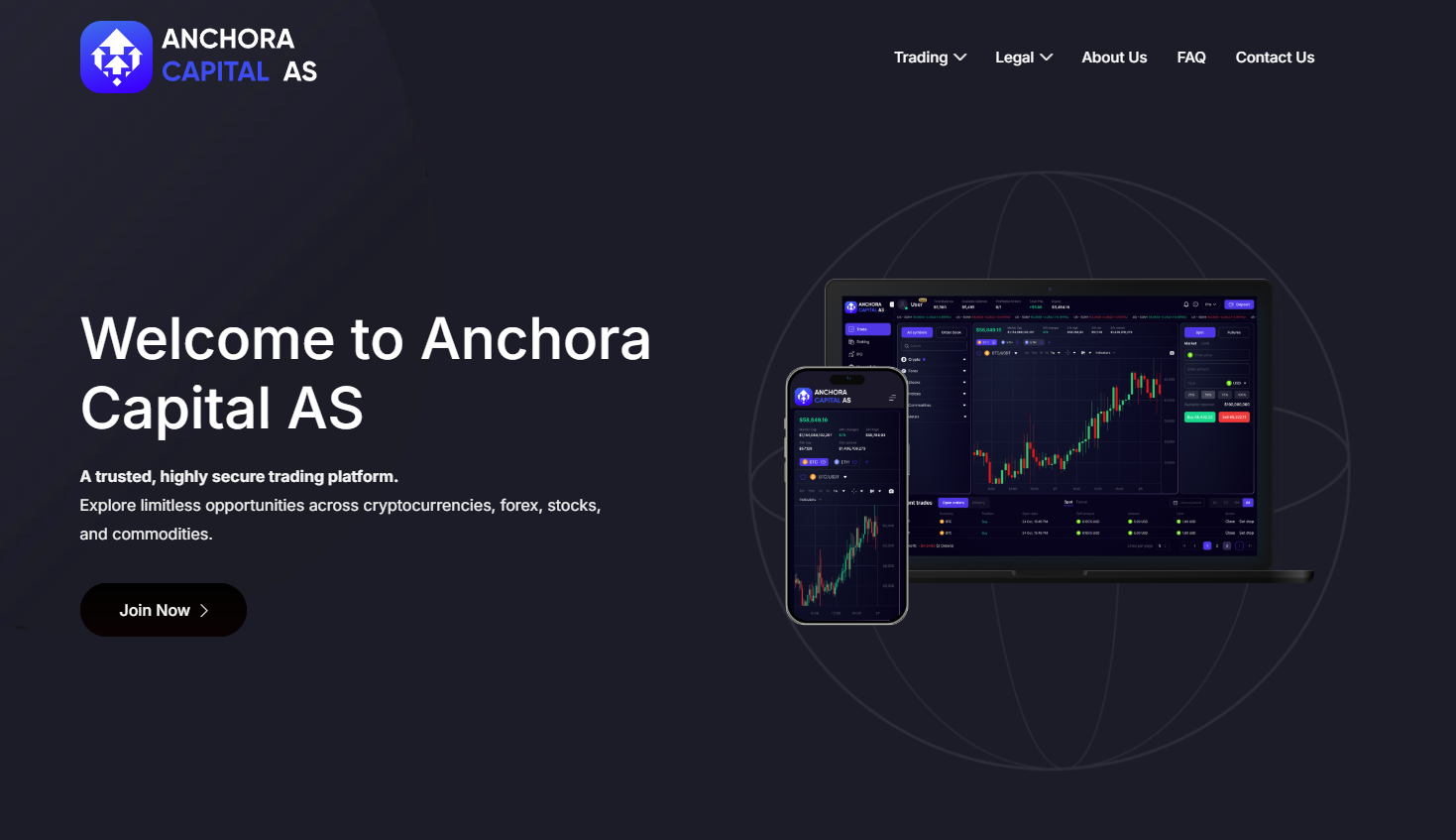
The platform is browser-based and does not appear to rely on a widely established third-party trading terminal. The company instead directs clients to its own web environment.
From a marketing perspective, the offer is straightforward: low starting capital, access to multiple markets and leveraged trading. From a due-diligence perspective, however, the more important issue is who actually stands behind the service.
That information is not presented with sufficient clarity.
Corporate Information Raises Questions
A financial company should make its corporate identity easy to verify. In the case of Anchora Capital AS, the available information does not provide a clear and independently verifiable picture of the legal entity operating the website. The company has reportedly referred to the Marshall Islands as its jurisdiction and provided an address in Majuro.
The claimed registration could not be confirmed. This is significant because offshore registration is not automatically evidence of wrongdoing. There are legitimate companies incorporated in offshore jurisdictions. The problem is the inability to verify that the entity named by the broker actually exists and operates the website in question.
Without a confirmed registration number and matching corporate records, a client cannot establish who would ultimately be responsible for the account.
The Name Anchora Capital Is Not Enough
The company name creates another potential problem. There are genuine businesses using the Anchora Capital name or similar names in Europe. One Norwegian company called Anchora Capital AS has a genuine LEI record, while another organization, Anchora Capital GmbH, operates in Germany. This does not mean either company is connected to anchoraas. com.
On the contrary, the existence of legitimate companies with similar names makes precise identification even more important. A trader searching for Anchora Capital could easily encounter information about a completely different organization and assume that it belongs to the broker they are considering.
The legal name alone therefore proves very little.
The relevant entity must be matched through its registration details, address, website, regulator and other corporate identifiers.
The LEI Code Used by the Broker
Anchora Capital AS has reportedly displayed the LEI code 254900PH979J802A2B70.
The code itself is associated with a real Norwegian company. However, that fact does not establish that the Norwegian entity operates the anchoraas. com website.
The LEI record identifies a company in Oslo and associates it with a different web presence. The entity is also described as a fund rather than as the online brokerage platform promoted through anchoraas. com.
This distinction should not be overlooked.
An LEI identifies a specific legal entity. It does not give another company permission to use that identity, and it does not prove that two websites belong to the same organization.
Consequently, the presence of a genuine LEI number on a website should never be treated as proof of brokerage authorization unless the underlying entity and its connection to the platform can be independently established.
Claims About the Company’s History
Anchora Capital AS has reportedly presented itself as an established business operating since 2008 and has claimed a customer base of more than 10 million users.
Those are substantial claims.
Yet the current anchoraas. com domain was registered on August 20, 2026.
The domain date alone cannot prove that the business itself was created in 2026. A company may change domains or launch a new website. However, there is no convincing independent evidence demonstrating that the current platform is part of an operation that has actually been serving millions of customers since 2008.
For a company claiming such a long history, the lack of a substantial public record is difficult to overlook.
A genuine international broker with millions of clients would normally leave extensive traces across regulatory databases, corporate records, financial publications and independent industry sources.
Licensing Information
Regulation is one of the first things a prospective broker client should verify.
Anchora Capital AS reportedly refers to CySEC licensing in its materials. However, the available information does not establish that the operator of anchoraas. com is actually authorized by CySEC.
This distinction is critical.
A website can mention a regulator, display a regulatory logo or publish a license number. None of those things should be accepted at face value.
The exact legal entity must be found in the regulator’s official register, and the authorization must cover the services the broker is offering.
If that verification cannot be completed, the broker should not be treated as a regulated financial institution simply because its website says otherwise.
Trading Conditions Offered to Clients
The broker promotes a relatively accessible entry point.
A minimum deposit of $100 makes the platform accessible to traders who do not want to commit a large amount of capital at the start. Leverage of up to 1:100 is also advertised.
The available markets reportedly include:
- Forex and fiat currencies
- Stocks
- Cryptocurrencies
- Commodities
On paper, this creates a broad product offering.
The difficulty is determining the actual cost of trading. Information about spreads, commissions and other charges is not presented with the level of transparency normally expected from a well-established broker.
When important pricing details have to be obtained through a manager rather than clearly documented before registration, clients have less opportunity to compare the broker with regulated alternatives.
A Browser-Based Trading Terminal
The trading account is accessed through a web platform hosted on a separate subdomain.
There is nothing unusual about a broker providing browser-based trading. The concern lies elsewhere.
The platform itself does not demonstrate where orders are executed or whether trades are actually passed to external markets.
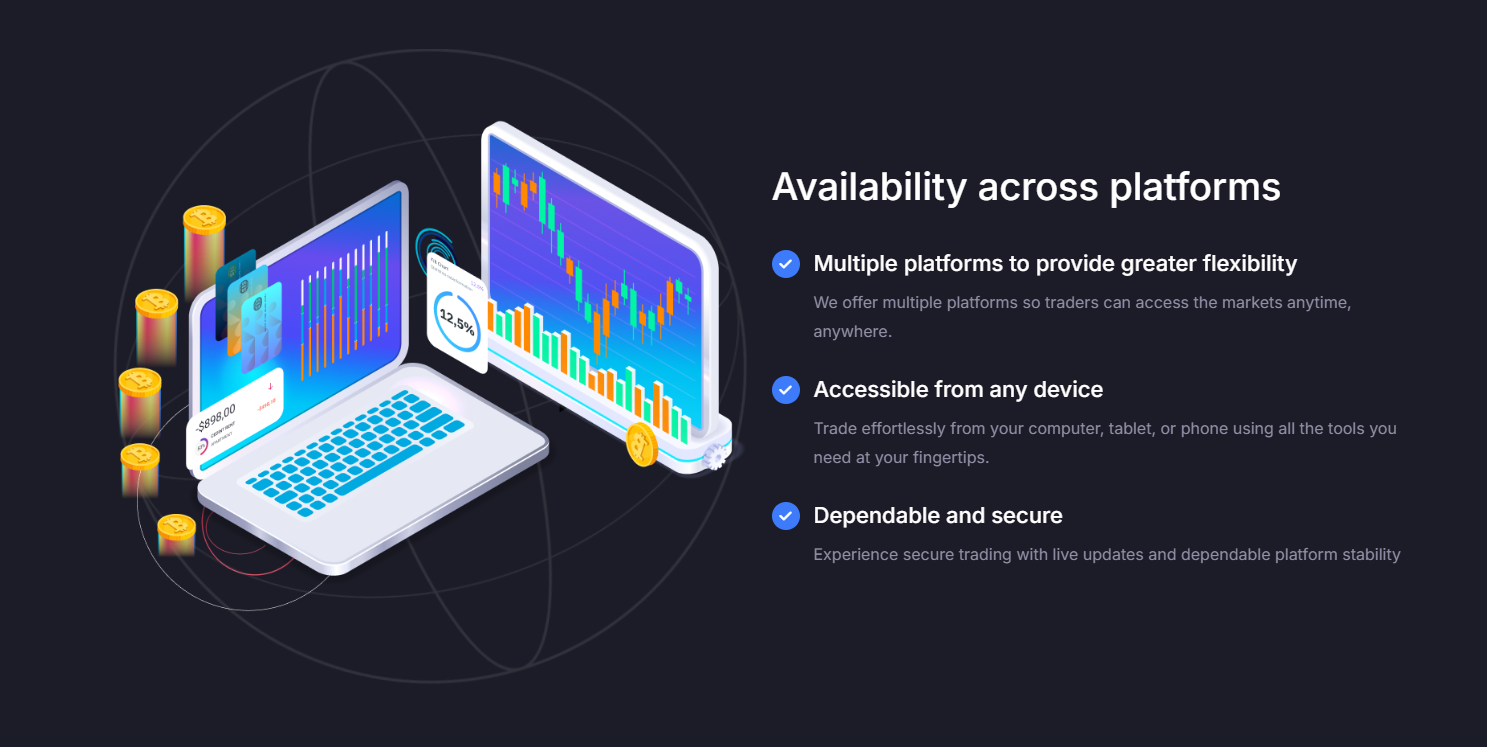
A client can see a live-looking interface, account balance and trading positions without having independent confirmation that the corresponding transactions exist outside the platform.
This is particularly relevant when dealing with an operator whose corporate and regulatory status has not been established.
The functionality of a trading terminal should therefore not be confused with proof of market execution.
Promotional Bonuses
Another part of the offer involves deposit bonuses.
Bonuses can be an effective acquisition tool because they make an account appear larger immediately after a deposit. A client who receives a substantial bonus may also be more willing to increase their initial investment.
The problem is that bonuses can come with withdrawal restrictions.
Before accepting such an offer, a trader should know whether the bonus is withdrawable, what trading volume is required and whether the bonus changes the conditions for withdrawing genuine funds.
This information should be available in clear contractual documentation rather than being explained informally by a sales representative.
How the Withdrawal Process Can Become a Problem
The ability to withdraw money is more important than the ease of making a deposit.
Reports concerning Anchora Capital AS describe a familiar pattern in which a withdrawal request can lead to demands for additional payments.
The explanation may involve a tax, insurance payment, withdrawal commission, conversion charge, account verification or alleged contractual penalty.
Regardless of the terminology, the basic issue is the same: the client is told that another payment must be made before the existing balance can be released.
This is a major warning sign.
Legitimate fees can exist in financial services, but they should be clearly established in the broker’s contractual documentation. A demand for an unexpected external payment as a condition for receiving one’s own money requires particularly careful verification.
Sending another payment simply because a representative promises that the withdrawal will then be released can increase the client’s losses without solving the original problem.
Cryptocurrency Funding
The availability of cryptocurrency deposits creates an additional risk for clients.
Crypto transactions are generally irreversible once completed. If money is transferred to a wallet controlled by an unidentified operator, recovering the funds may be considerably more difficult than disputing a conventional card transaction.
This makes pre-deposit verification essential.
A client should establish the legal identity of the recipient, the jurisdiction of the company, its regulatory status and the contractual basis on which client money is held.
Without that information, sending cryptocurrency to a broker’s wallet creates significant counterparty risk.
Contact Details and Client Support
The primary published contact appears to be the support@anchoraas. com email address, alongside an online chat available through the client area.
The company does not provide the type of detailed corporate contact information that would make independent verification straightforward.
The absence of a clearly identifiable telephone contact is another limitation, although this alone would not establish misconduct.
The more important concern is what happens if the client account becomes inaccessible or a withdrawal dispute develops. An internal chat system is not an adequate substitute for a clearly identified legal entity and formal complaint procedure.
Domain History
The current domain provides another useful point of comparison with the broker’s claims.
anchoraas. com was registered on August 20, 2026.
The domain also has very limited historical information compared with what would normally be expected from a company claiming almost twenty years of operating experience.
Again, this does not prove that the business itself was established in 2026.
It does, however, mean that claims about the company’s history should be supported by other independent evidence. At present, the available information does not provide enough evidence to confidently connect the current website with the alleged 2008 launch.
A Broker With Too Many Unanswered Questions
The main concern with Anchora Capital AS is not one isolated issue.
Several elements need to be considered together.
The claimed corporate registration cannot be independently established. The reported CySEC authorization has not been confirmed. The LEI code displayed by the broker belongs to a genuine Norwegian company, but there is no sufficient evidence connecting that company with anchoraas. com.
The current domain is also very recent, despite claims of a much longer business history.
At the same time, the website provides limited information about the legal operator, trading costs and client-fund arrangements.
For a financial platform asking clients to deposit real money, that level of uncertainty is unacceptable.
Final Verdict on Anchora Capital AS
Anchora Capital AS does not provide enough independently verifiable information to be considered a transparent and trustworthy broker.
The company’s presentation focuses on broad market access, low deposits and leveraged trading, but the basic questions surrounding its legal identity and regulatory status remain unresolved.
The presence of a real Norwegian company with the same name should not be interpreted as validation of the website. The same applies to the LEI code displayed on the platform.
The available evidence instead points to a broker that should be treated with substantial caution.
Potential clients should verify the exact legal entity behind anchoraas. com, confirm its registration independently and check any claimed financial license directly with the relevant regulator before transferring funds.
If the platform has already accepted a deposit and subsequently demands additional money before processing a withdrawal, sending further funds should be avoided until the demand has been independently verified.
Based on the available information, Anchora Capital AS operating through anchoraas. com should be regarded as an unverified and high-risk broker rather than an established regulated financial intermediary.

Reader reviews (0)
No reader reviews yet